



Summer reading: “Whispers in the Graveyard”…
Whilst rummaging through my bookshelf, I came across Whispers in the Graveyard, a book written by the Scottish author Theresa Breslin…
I’ve already mentioned Theresa Breslin in Scotiana in a post called The Magic of Scottish Folk and Fairy Tales for Christmas…
Then, the mystery of fiction will lead us to mysterious real Scottish kirkyards…

Whispers in the Graveyard Theresa Breslin Methuen 1994
1 – The Book
A book for children?
Whispers in the Graveyard is a book described as “for children”.
Personally, I’ve always found that label far too restrictive…
A passionate reader since childhood, I never stopped reading children’s books and, in many cases, the distinction between children’s and adult literature is far less clear-cut than one might think. Some stories simply speak to every age.
I could mention a number of Scottish books that continue to delight both adults and younger readers alike: the novels of Stevenson and Walter Scott, Andrew Lang’s Fairy Books, JK Rowling‘s Harry Potter series to name but a few…
As a child, I read absolutely everything that came my way, across very different literary genres. I spent as much time as possible in the local library — a very ancient library situated in one of the city’s oldest and most picturesque streets, beside the magnificent Gothic cathedral. There, I invariably tried to borrow books from the adult section… though I was never allowed to, of course 😉.
A fantasy book?

Whispers in the Graveyard London Mammoth 2000
A fantasy book?
In part, yes. Whispers in the Graveyard can certainly be described as a fantasy novel. Yet some of its key themes could hardly be more deeply rooted in real life.
The story unfolds in the dark and disturbing setting of a Scottish kirkyard, where supernatural elements mingle with old beliefs and historical realities. The sudden reappearance of a vengeful witch — burned at the stake long ago and accidentally released when greedy people open her grave — sends shivers down the spine not only of the book’s young hero, but also of the reader.
Beyond the suspense, the novel also touches upon the very real history of the witch-hunt in Scotland
The two covers shown above provide perfect gateways into the atmosphere of the story itself. On the first one (the Methuen edition), a solitary child wanders among leaning gravestones beneath the twisted branches of a bare tree — a rowan tree, as we later discover, sacred in Scottish tradition and long associated with protection against evil. The second cover (the Mammoth edition) captures the gloomy atmosphere of an old Scottish kirkyard perfectly 😉.
Theresa Breslin was born in the heart of Scotland, in Kirkintilloch, Dunbartonshire. It is therefore hardly surprising that her story should feel so deeply rooted in Scottish soil — in its ancient beliefs, silent graveyards, protective trees and lingering whispers from the past.
Published in 1994 and awarded the prestigious Carnegie Medal, the novel appeared only a few years before Harry Potter and the Philosopher’s Stone by J.K. Rowling. Though very different in tone, both books seem to belong to that fascinating moment when British children’s literature once again embraced darkness, folklore and the unseen world.
Then, from fiction, it is only a small step towards the real Scottish kirkyards that still preserve so many traces of these old beliefs…
2 – Solomon’s graveyard…

Solomon in the churchyard – Source Whispers in the Graveyard Bookey
In the opening chapter of Whispers In The Graveyard, we follow Solomon, the young narrator, on his way to school, as he walks through the cemetery between the rows of old leaning graves.
My footprints track cross the faint dew still lying on the grass. My boots crunch heavily on the hard gravel path… but the residents lodged on either side of these avenues won’t complaint about the noise.
They’re dead.
Every one of them. »
Far from fearing the kirkyard, Solomon seems strangely at home there.
He loves studying the old carved stones and often pauses before his favourite graves, fascinated by their mysterious symbols. His father has taught him how to decipher the emblems engraved upon the tombs, and Solomon knows them all: the weaver’s grave, marked with a leopard carrying a shuttle in its mouth, or the old tinker’s grave with its ram’s horns and crossed spoons.
“I lean against the tombstones. The familiar carvings of winged souls and hourglasses are old friends. These markings I can read and understand. I run my fingers over them. The crumbling old stone, mellow and marmalade-coloured, is warm beneath my fingers…”
This passage is particularly striking because the cemetery is not presented as a frightening place, but almost as a refuge — a world Solomon understands far better than the living world surrounding him.
Whenever he feels unhappy, caught as he is between a stupid and cruel teacher who torments him every day at school and a much-loved but alcoholic father at home, Solomon retreats to a secluded corner of the kirkyard where he has created a secret hiding place for himself:
“I climb up and pull away some of the stones. There’s a ledge where I can lie, out of sight. I’ve got stuff stashed here. Emergency rations for when I dog off school and can’t go home. An old blanket, comic books, biscuits, cans of juice…”
Throughout the novel, some of the most important scenes unfold within the cemetery itself, while others take place at school or in Solomon’s difficult home environment. Yet the kirkyard remains at the heart of the story — not merely as a setting, but almost as a living presence, filled with memory, symbols and whispers from the past.
And in many ways, the old Scottish kirkyards described by Theresa Breslin are not entirely fictional. Across Scotland, one can still wander among leaning gravestones covered with carved symbols, weathered urns, winged souls and ancient trees — silent witnesses to centuries of beliefs, traditions and forgotten lives…
3 – From Fiction to real Scottish kirkyards…
Reading this book whose story is set largely within the ancient walls of a cemetery immediately brought back memories of the old Scottish kirkyards we visited over the years…
I have always loved wandering through graveyards. Ever since childhood, they have never felt frightening or morbid to me. Quite the opposite: I find there a profound sense of peace and quietness.
I read gravestones almost like books. Names, dates, worn inscriptions and carved symbols all seem to whisper fragments of forgotten lives. I often find myself imagining the people behind the stones — who they were, what they loved, what kind of Scotland they once knew.
Perhaps this is why Whispers in the Graveyard resonates with me so deeply.

Celtic cross in Warbeth cemetery Orkney © 2003 Scotiana
Scottish kirkyards are far more than burial places. Over the centuries, they have become repositories of stories, memories and legends — places where history, literature and folklore seem to meet beneath the same weathered stones.
Some belong to poets and novelists whose works shaped Scotland’s literary imagination; others are linked to Jacobite heroines, clan chiefs, ministers, outlaws or even ghost stories and fairy lore. Each kirkyard seems to preserve its own atmosphere, its own whispers from the past.
3-1 – Kirkyards of Scottish writers and poets…
Here are some of the Scottish kirkyards that left the deepest impression on us over the years…

Alloway’s Church was drawing near,
Where ghosts and owls nightly cry.(…)
Before him the river Doon pours all his floods;
The doubling storm roars throught the woods;
The lightnings flashes from pole to pole;
Nearer and more near the thunder rolls;
When, glimmering through the groaning trees,
Alloway’s Church seemed in a blaze,
Through every gap, light beams were glancing,
And loud resounded mirth and dancing.
(Tam o’ Shanter – Robert Burns 1790)

Alloway Auld Kirkyard sign © 2012 Scotiana2
George Mackay Brown: Stromness cemetery…

Stromness Cemetery Orkney© 2003 Scotiana
We went to Orkney not only to visit some of the world’s most famous archaeological sites, but also to walk in GMB’s footsteps and immerse ourselves in the atmosphere of the places that inspired him so deeply.
We didn’t want to leave without paying our respects at his grave in the beautiful Warbeth Cemetery, set in one of the most beautiful seascapes we’ve ever seen, overlooking Hoy Sound, one of the favourite places of GMB.

GMB’s grave in Warbeth Cemetery – Orkney © 2003 Scotiana
To have carved on the days of our vanity
A sun
A ship
A star
A cornstalk (..)
Here is a work for poets –
Carve the rune
Then be content with silence”
(From the poem ‘A Work for Poets‘ – George Mackay Brown -1996)
That says it all; there’s nothing more to add…

We never left this wonderful place without leaving a wee something on the gravestone: a rose, a bunch of daffodils, a beautifully coloured pebble smoothed by the sea, a tiny little bear… and our boundless gratitude for the immortal and sublime legacy the poet has left us…
– Iain Crichton Smith: Taynuilt Kirkyard…

Iain Crichton Smith’s grave in Taynuilt kirkyard © 2006 Scotiana
When everything trembles,
Only Love holds it together
The leaf is stronger than the marble.
(From The Leaf and the Marble – Carcanet 1998)
It was Iain Crichton Smith’s book Consider the Lilies that inspired our first trip to Scotland in 2000 and it took us all the way to the far north of the country along the Clearances Trail, to Bettyhill and the ruins of the village of Rosal where the book’s story is set, to the memorial cairn to Macleod which stands in Strathnaver, opposite the deserted township site where he and his family once lived…
Iain Crichton Smith was a born story-teller and famous for his short-stories and poems. Short stories are my favourite literary genre and I do love ICS’s stories…
We searched for a long time the location of ICS’s grave, and ever since we found it, we haven’t failed to stop by and lay some flowers whenever we pass through Taynuilt, the village where the author lived with his wife and the place where he rests in the local cemetery.
Last time we went there (winter 2019-2020) it was Christmas time. Night had fallen when we pushed the gate of the cemetery…
It was a cold night. The hoot of an owl, the barking of a dog in the distance, and right beside us, hanging from the branches of a bare tree, a string of Christmas lights twinkled and sparkled in the night… everything contributed to making this a moment I shall never forget…

Lighting candles on ICS’s grave at Chrismas time© 2019 Scotiana
A unique moment forever associated with the writer in whose memory we were lighting the little triskelion-shaped candles our daughter had given us before leaving…

Taynuilt Inn – Christmas time 2019 © 2019Scotiana
Once our candles were extinguished, we made our way back to the Taynuilt Inn, completely frozen but very happy. A nice hot Scottish soup was waiting for us, and the innkeepers told us that they knew Donalda, Iain Crichton Smith’s wife, well and that they would pass on our message of friendship to her.
It was high time to drive to our hotel in Oban, Columba Hotel…
– Sir Walter Scott: Dryburgh Abbey…
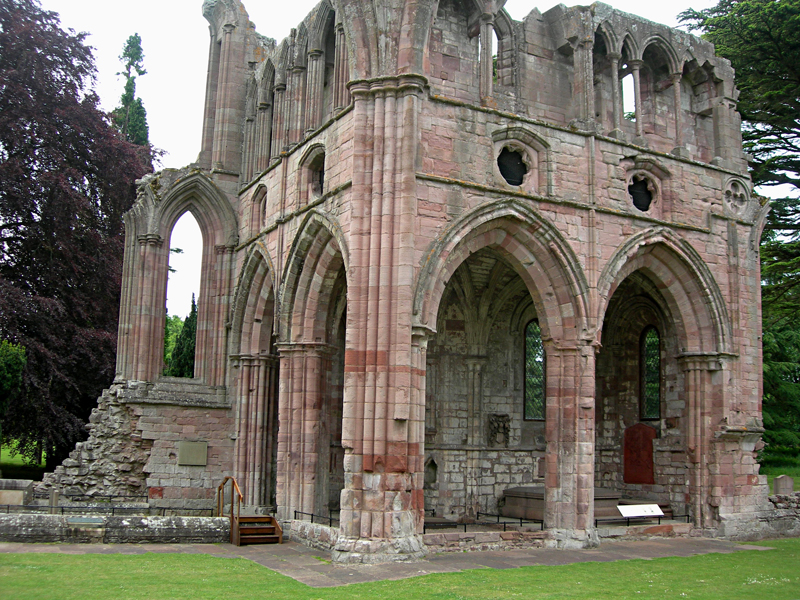
Dryburgh Abbey Walter Scott’s grave © 2006 Scotiana
What traveller could remain unmoved by the spellbinding beauty of the ruined abbeys that dot the landscape of the Scottish Borders? Melrose, Kelso, Jedburgh, Dryburgh… the latter being, along with Melrose, our favourite Scottish abbey.
We never fail to pay our respects at the grave of Sir Walter, who adored this wonderful place and chose to be laid to rest here forever.
As I wander amongst the ancient tombs surrounding the abbey in a setting that couldn’t be more romantic. I wouldn’t be all that surprised to come across the evanescent figure of the ‘Magician of the North”… just as I always expect to when I visit Abbotsford 😉
In the 1700s, the ivy-clad ruin attracted the attention of David Erskine, 11th Earl of Buchan and chief founder of the Society of Antiquaries of Scotland.
Buchan bought Dryburgh House and set about creating a charming landscape in which the ancient abbey figured prominently. When he died in 1829, he was laid to rest in its sacristy.
Sir Walter Scott, antiquarian and novelist, and Buchan’s close friend, was buried here three years later, on 26 September 1832. His tomb is in the north transept (which he called ‘St Mary’s Aisle’).
A third great Scot, Field-Marshal Earl Haig, was interred beside Scott in 1928.

Dryburgh Abbey wooded park © 2006 Scotiana
Amidst magnificent trees whose venerable age makes them witnesses to the abbey’s history since its distant beginnings in the 12th century… let us sit for a moment on an old gravestone in their shade and listen intently to try to make out the whispers of these precious witnesses…
– James Hogg

James Hogg’s grave in Ettrick © 2012 Scotiana
When first, descending from the moorlands,
I saw the Stream of Yarrow glide
Along a bare and open valley,
The Ettrick Shepherd was my guide.
When last along its banks I wandered,
Through groves that had begun to shed
Their golden leaves upon the pathways,
My steps the Border-minstrel led.
The mighty Minstrel breathes no longer,
‘Mid mouldering ruins low he lies;
And death upon the braes of Yarrow,
Has closed the Shepherd-poet’s eyes…
(From ‘Extempore Effusion upon the Death of James Hogg’ – William Wordsworth)

James Hogg Monument © 2012 Scotiana
– Robert Burns Mausoleum in Dumfries…
-
Alloway Auld Kirk
Can you name the most famous church in Scotland? That’s probably an unanswerable question, though Greyfriars and St Giles’ in Edinburgh are inevitably high on the list because of their historical significance, along with Iona Abbey.
But if anyone were really to draw up such a list, then the church shown here would probably feature very strongly.
Auld Kirk Alloway carries a date suggesting that one stage of its building took place in 1516, though parts are thought to date back to the 1200s: including a stone grave slab later reused as a window lintel.
The presence of a nearby well dedicated to St Mungo adds weight to the view that this may have been a place of worship from a very early date. (…)
The kirkyard is much more interesting than the kirk itself.
Greeting the visitor as you enter is the grave of Robert Burns’ father, William Burnes (though the gravestone uses the spelling of the family name preferred by Robert and his brother).
In the rest of the graveyard there is a an exceptional collection of pictorial gravestones.(..)
In some cases the occupation of the person buried underneath is obvious from the pictures carved on the gravestone: and the stones of a blacksmith and a miller are amongst the best you will see anywhere in Scotland. Many gravestones also carry an engraving of an hour-glass. If this is upright, the person buried underneath died a natural death. If it is lying on its side, then they died “before their time”.
(Source : Undiscovered Scotland)
-
Burns Mausoleum and Monument

St Michael’s Church and kirkyard Dumfries © 2012 Scotiana
The tolling of a bell, the cry of a night bird, a fleeting shadow… Janice isn’t likely to forget our nighttime visit to the Dumfries cemetery… it must be admitted that the atmosphere of any city of the dead after dark is anything but cheerful, except that Robert Burns’ mausoleum stood out against the night in all its whiteness, and the sight was truly unforgettable…

Robert Burn’s mausoleum – St Michael’s Kirkyard – Dumfries © 2012 Scotiana
Robert Burns was initially buried in the north-east corner of St Michael’s Churchyard, but before long his growing army of devoted fans began to feel that his existing grave was insufficient recognition for his genius. A circular was published on 29 November 1813 calling for the public to subscribe to the cost of a mausoleum. 18 local worthies attended a meeting in the George Inn in Dumfries held on 16 December 1813, and the project was launched.
Amongst those who took a leading part in the fund raising campaign was Sir Walter Scott. Money flowed in from all over Great Britain and from as far afield as India and America. By spring 1815 enough funding was in place for the work, based on a design by Thomas Hunt of London, to be put out to tender. The contract was won by a local stonemason, John Milligan…
A midnight on 19 September 1817, Burns’ remains were disinterred from his original burial place, along with those of two of his sons, who had died at the ages of 9 and 2…
Source: Undiscovered Scotland.

Inside Robert Burn’s mausoleum – St Michael’s Kirkyard – Dumfries © 2012 Scotiana
– Hugh MacDiarmid in Langolm cemetery…

Hugh MacDiarmid’s grave in Langholm cemetery © 2012 Scotiana
1892-1978
‘I’ll hae nae haufway hoese, but aye be whaur
Extremes meet – it’s the only way I ken
To dodge the cursed conceit o’ bein’ richt
That damns the vast majority o’ men.’
(Hugh MacDiarmid’s epitaph from ‘A Drunk Man Looks at the Thistle’ – 1926)
Hugh MacDiarmid is buried in Langholm Cemetery, Dumfries and Galloway (the cemetery lies one mile south of Langholm).
Contrary to our visit to ‘Brownsbank Cottage’, Hugh MacDiarmid’s house perched amid the Peeblesshire hills near Biggar, a charming little white cottage with its blue shutters and filled to the brim with books and personal memories,
…contrary to our unforgettable walk to the magnificent memorial dedicated to the poet,
we don’t have an unforgettable memory of Langholm Cemetery… but the epitaph inscribed on the poet’s grave is entirely in keeping with his character…
But the spirit of the great man must be elsewhere anyway…who knows?
… perhaps in the Scottish Parliament during a heated debate on independence… wandering in the wild landscape of the Shetlands where he lived for a time… or sitting at a table with his writer friends at Milne’s Bar on the corner of Hanover Street and Rose Street in Edinburgh…
The Rose of all the world is not for me
I want for my part
Only the little white rose of Scotland
That smells sharp and sweet – and breaks the heart.
(Hugh MacDiarmid)
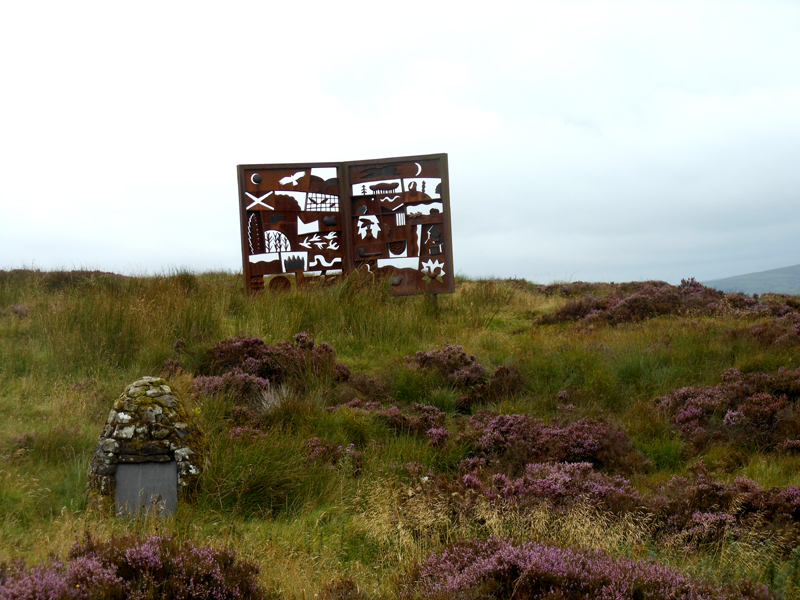
MacDiarmid memorial © 2012 Scotiana
‘Perched atop Whita Hill stands the Hugh MacDiarmid Memorial overlooking Langholm which is the birthplace of the Scottish poet. Crafted by sculptor Jake Harvey and unveiled in 1985, this homage takes the shape of a colossal open book, forged from cast iron.
Within the pages of this literary tribute, intricately laser-cut images from MacDiarmid’s poetic repertoire come to life. Iconic symbols like the thistle, the Auld Licht Kirk, and the Common Riding emerge, capturing the essence of his verses and the landscapes that inspired them.’
3-2 – Kirkyards of legends and folklore…
Rob Roy’s grave in Balquiddher
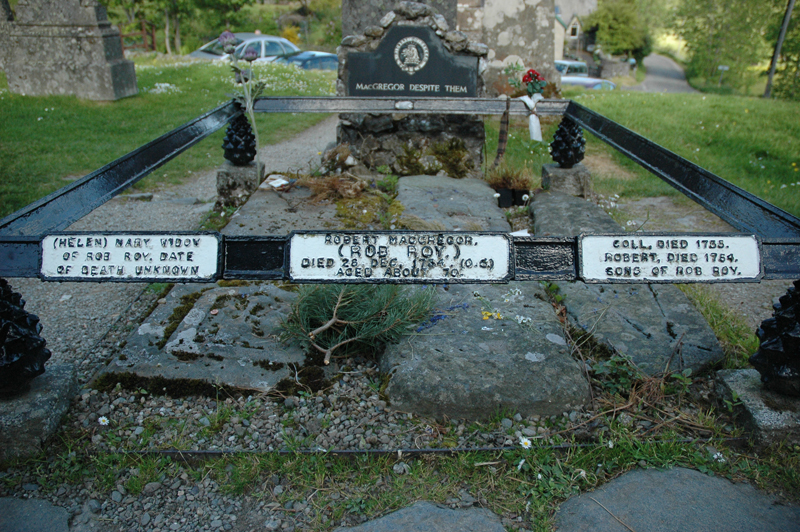
“MacGregor Despite Them”
“Judged by Scott’s novel, the biggest, bravest heart that ever beat beneath the MacGregor tartan was that of Rob Roy, so named from the colour of his hair and his fresh, ruddy complexion. Scott did not create the Rob Roy of romance. He idealises, no doubt, but his interpretation of the character of Rob rests mainly on the popular tradition of the man. A descendant of the blood-thirsty Dugald Ciar Mohr, Rob had all his ancestor’s love of the sword and capacity for leadership, without his cruelty. (…)
Rob was the third son of Donald MacGregor of Glengyle [probably born in 1671 and not in 1660 as given by the Clan History nor 1666 as assumed by Sir Walter in his novel]. (…) Like all his tribe, Rob MacGregor had to assume another name. He took his mother’s, who was a Campbell of Glenfalloch, and he became Rob Roy MacGregor Campbell. (…)
In Rob’s more reputable epoch he was the occupant of grazing land in Balquhidder, a cattle-drover on a fairly extensive scale, doing business as far south as the Tweed and the Solway. It was a stroke of ill-luch which changed the whole current of Rob’s career and made possible the Rob Roy of Highland legend and romance. (…)
Scott had listened to Rob Roy’s story from those who knew Rob personally, and who gave him a high character for beneficence and humanity [a kind of “Scottish Robin Hood”].”
(The Scott Originals – “Rob Roy” – WS Crockett)
Reverend Kirk

Doon Hill – Reverend Kirk Grave – Scotiana.com – 2004
We visited Doon Hill in 2004 and 2006 and I remember pretty well our first visit there.
There are three designs on the stone: an etched thistle, to represent his Highlands background; a shepherd’s crook, to represent his calling; and a dagger…
The mysterious life of Reverend Kirk is one of the most enigmatic in Scottish history and has already been the subject of several posts on Scotiana, including Janice’s post published in November 2025 and entitled Symbols on Reverend Kirk’s Gravestone in Aberfoyle.
To understand the meaning of the dagger I invite you to read the very good article written by Louis Stott and entitled The Reverend Robert Kirk
https://en.wikipedia.org/wiki/Robert_Kirk_(folklorist)
Greyfriars Bobby

Greyfriars Bobby’s gravestone Edinburgh © 2001 Scotiana
One of the most famous of Scottish animal stories took place in Edinburgh, at the end of the 19 th century. It is a true story about a disconsolate little Skye Terrier, called Bobby, who spent 14 years on the grave of his master, after his death in 1858. He soon became a local hero and then got a well-deserved international fame as many of his fellow-creatures: Lassie in Britain, Mabrouk and Junior in France, Hatchi in Japan to mention only a few of the most unforgettable dogs.
A gravestone has been erected in Bobby’s memory at the entrance gate of Greyfriars’s Churchyard, in Edinburgh, not far from the place where his master rests but I’m not sure the little dog has been buried there. Everybody knows the little dog as Greyfriars’ Bobby. (…)
A bronze statue designed in 1872, by William Brodie has also been erected , in the 1960s, by Baroness Burdett-Coutts in memory of the faithful little Skye Terrier, at the junction of Candlemaker Row and George IV Bridge in Edinburgh. (…)
Greyfriars’ churchyard with Bobby’s and Old Jock’s stones, Greyfriars Bobby’s Bar and his monument are pilgrimage places for dog lovers and landmarks for tourists in Edinburgh! We went there several times and, in 2007, after waiting our turn for a long long time, we finally ate a delicious meal in the crowded pub which contains a number of moving memorabilia of Bobby, of his master and of his friends…
On learning about this very moving story, in 2000, we promised to call at the little dog’s grave next time we would go to Edinburgh. (…)
In 2003, while I was walking along the dark and solitary alleys of the churchyard, looking at the graves and taking pictures of the place, an old man suddenly emerged from I know not where and began to tell me Bobby’s whole story in a very lively style and all sorts of anecdotes about Greyfriars’ churchyard. Indeed, this churchyard is well worth the visit in itself for it is a highly historical place.
My old storyteller looked rather wretched and I wondered if, like Bobby in his time, he lived in the neighbourhood in some makeshift and weatherbeaten shed. Maybe the old man was working there. Anyway, he seemed to know the place quite well and I thought he must also be a regular at the nearby Greyfriars’ pub I would lie if I told you that I understood all things he said to me that day but I took to the old man and promised him I would come back soon.
We came back in 2006 but the old man was no longer there. I would have been pleased to see him hobbling along the path…but maybe it was his turn to peacefully rest there, in his dear churchyard…
(From my post Greyfriars Bobby, Moobli and Rangi : On The Track of Three Unforgettable Dogs in Scotland with Ralph)

Edinburgh Greyfriars’s Bobby Bar © 2003 Scotiana
3-3 Hauntingly beautiful Kirkyards, on the road…

Kildrummy Churchyard © 2015 Scotiana
Travelling through Scotland, we could never resist stopping whenever an old kirkyard appeared not far from the road, surrounding an ancient church battered by wind and rain (or not 😉).

Boleskine churchyard © 2000 Scotiana
Boleskine cemetery
The B852, a solitary and peaceful road running alongside Loch Ness between Inverfarigaig and Foyers
The loch reflects the mountains rising on the opposite shore. We stop. A sign reads: “The Boleskine burial ground“.
A gate creaks open — as gates in old cemeteries always seem to do. Beyond it stand ancient cypress trees, weathered gravestones and a small slate-roofed building which I later learn is a mort house, the only surviving one in the Highlands of Scotland.
With the exception of Glasgow’s vast Necropolis — which can hardly be described as a traditional kirkyard — Boleskine was the very first cemetery we visited during our travels through Scotland, on our long road northward.
Somewhere nearby lie the ruins of Boleskine House, once owned by Aleister Crowley and later by Jimmy Page of Led Zeppelin fame. Unsurprisingly, the place has gathered its share of dark legends over the years…”

Balkaneil © 2003 Scotiana
Balnakeil cemetery…
Balnakeil, a little over a mile north-west of Durness, feels almost unreal in its beauty.
The old ruined church stands above the dunes overlooking Balnakeil Bay, surrounded by gravestones bent by centuries of Atlantic winds. Beyond stretches a sublime landscape of white sand, sea and sky.
Like so many Scottish kirkyards, the place possesses that strange mixture of melancholy and serenity so characteristic of the Highlands and Islands.
Skipness Kirkyard…

Skipness chapel and churchyard Kintyre © 2004 Scotiana
Some kirkyards seem to belong entirely to silence.
Skipness, on the shores of Loch Fyne, is one of them.
The ruined chapel, ancient gravestones and lonely coastal setting create an atmosphere that feels almost untouched by time. One can easily understand why old Scottish kirkyards inspired so many ghost stories, legends and supernatural tales.

Skipness Chapel and kirkyard Kintyre© 2004 Scotiana
Cill Chriosd on the Isle of Skye

Cill Chriosd kirkyard – Skye © 2006 Scotiana
Cill Chriosd or Kilchrist (Christ’s Church) is a ruined former parish church of Strath (including the cleared villages of Boreraig and Susinish), on the Isle of Skye, Scotland. It was constructed around the 16th century, replacing an earlier medieval church on the same location, and was used until 1840 when the parish church was relocated to Broadford. It lies on the B8083 Broadford to Torrin and Elgol road.
The location is thought to have a heritage of Christian worship dating back to the 7th century, when St Mael Ruba preached from nearby Cnoc na-Aifhreann (“hill of the mass”).
The original parish church for Strath was located at Ashiag, and was founded by St Mael Ruba in the 7th century; the new parish church was relocated to this location in the later Middle Ages. The present ruined church probably replaced the first medieval stone church in the 16th century.

Cill Chriosd on the Isle of Skye © 2006 Scotiana
3-4 The great Necropolis of Glasgow

Glasgow Necropolis general view © 2001 Scotiana
And then there is Glasgow Necropolis.
A city within a city.
From its heights, one can look out over the whole of Glasgow while wandering among avenues of monumental tombs, obelisks and sculpted memorials bearing witness to the city’s prosperous Victorian past.
Unlike the ancient rural kirkyards scattered across the Highlands and Islands, Glasgow Necropolis belongs to another era altogether. Opened in 1832, it reflects the grandeur, ambition and wealth of industrial Scotland.
Yet despite its scale and magnificence, one still finds there the same fascination with memory, symbolism and the presence of the dead that runs through so many Scottish burial places.
And perhaps this is what makes Scottish kirkyards so fascinating: beyond their history and atmosphere, they are also filled with a rich visual language of symbols carved into stone — winged souls, skulls, urns, angels, hourglasses, trees, flowers and mysterious emblems whose meanings are often forgotten today.
The very same symbols that fascinated young Solomon in Whispers in the Graveyard…

Glasgow Necropolis women mourners © 2000 Scotiana
4 – Funeral Symbolism in Scotland

Christina Macnaughton Balquidder Kirkyard © 2006 Scotiana
Masons used trees and plants a lot on memorials, ivy and bay leaf, lilies, thistles and roses. It’s traditional. They used to strew flowers on graves in ancient times, and grow evergreens in kirkyards.
(Whispers in the Graveyard)
Some graves are heartbreakingly beautiful, very moving; others so old that time itself seemed to be erasing them little by little… forever lost pages of past time…
Who was Christina? I wonder…

As Solomon wanders amongst the gravestones, he recognises and understands the symbols carved upon them.
And indeed, one of the most fascinating aspects of old Scottish kirkyards lies in this rich and mysterious visual language engraved in stone…
Old graveyards speak in symbols as much as in names and dates.
Long before modern headstones became simpler and more practical, tomb carvings told stories about time, grief, faith, eternity, and even the trade or social role of the deceased. Walking among these stones feels almost like reading a silent language.

Alloway Auld Kirkyard & William Burns’s grave © 2012 Scotiana
When we visited Alloway Auld Kirkyard on 30 September 2012, we certainly did not expect to discover such a remarkable collection of pictorial gravestones. We lingered among the tombs for quite a long time, trying to decipher the many symbols carved upon them. Janice took so many photographs and close-up shots that she could probably write a whole book on the subject.

Alloway Aulk Kirkyard richly decorated stone © 2012 Scotiana
Among these funeral art treasures, I have selected the above richly carved stone, particularly striking because of its exceptional state of preservation. Since we do not possess Solomon’s wisdom when it comes to funerary symbolism, I searched the web and eventually found a detailed description of this fascinating monument on Scotland’s Scenery Facebook page.
“The Figure of Death extinguishing the Candle of Life, as Father Time counts down the days with his hourglass beneath Lady Justice and her scales. This amazing eighteenth-century Scottish stone at Alloway Kirk is crammed with grave iconography, memento mori symbols, and two finely carved flintlock pistols.”
The symbolism is indeed extraordinary. Death snuffs out the fragile flame of life while Time relentlessly measures the passing of our days. Above them, Justice presides over the scene with her scales, reminding us that all lives are ultimately weighed. The flintlock pistols are more enigmatic and may allude to the deceased’s profession, status or personal history. Whatever their meaning, the whole composition forms a powerful memento mori, a reminder of mortality carved in stone more than two centuries ago.
Now let us discover a few other gravestones… there are so many of them in Scotland…
The Passage of Time

Mary Young’s grave in Kirkwall Cathedral Orkney © 2003 Scotiana
Some symbols remind us that life is fragile and fleeting.
- Hourglasses — perhaps the clearest reminder that time runs out for everyone.
- Broken columns — a life cut short before its natural completion.
- Wilted flowers or drooping roses — fading beauty and mortality.
- Extinguished candles or overturned torches — the end of earthly life.
- Clocks stopped at a specific hour — the exact moment when time stood still for the deceased.
Death and Mourning

Sweetheart Abbey hourglasses & skull on a grave © 2004 Scotiana
Yikes! Enlarge the picture… isn’t that skull frowning at us ?
Victorian cemeteries especially are filled with symbols of sorrow and remembrance.
- Weeping willows — grief, mourning, and remembrance.
- Draped urns — sorrow veiled in mourning cloth.
- Skulls and crossbones — once common reminders of mortality rather than symbols of fear.
- Coffins, shrouds, or skeletal figures — more frequent on older medieval graves, confronting death directly.
- Hands pointing downward — God reaching down for the soul.
Eternity and Hope

Carradale Kintyre – anchor on a grave © 2003 Scotiana
Not all cemetery symbolism is dark. Many carvings express continuity, resurrection, or peace beyond death.
- Angels — guardians between earth and heaven.
- Open gates or doors — passage into the afterlife.
- Circles, wreaths, and rings — eternity without beginning or end.
- Doves — peace and the soul ascending to heaven.
- Butterflies — transformation and resurrection.
- Anchors — hope, steadfast faith, and safe passage.
- Lambs — innocence, often marking children’s graves.
Nature and the Seasons

Sweetheart Abbey – a tree stump carving on a grave © 2004 Scotiana
Nature appears everywhere in old cemeteries because it mirrors the cycle of life itself.
- Oak leaves and acorns — strength, endurance, and long life.
- Ivy — eternal attachment and memory.
- Laurel wreaths — victory over death.
- Poppies — eternal sleep and rest.
- Tree stumps — a life interrupted, often associated with fraternal organizations such as the Woodmen of the World.
Symbols of Trade and Occupation

Alloway Auld Kirkyard richly decorated blacksmith’s grave © 2001 Scotiana
Older graves sometimes revealed the profession of the deceased, especially in rural communities where identity was closely tied to work.

Alloway Kirkyard – blacksmith’s tool © 2012 Scotiana
- Hammer and anvil — blacksmiths and metalworkers.
- Sheaves of wheat — farmers and the harvest of life.
- Millstones or wheels — millers.
- Scales — merchants or traders, sometimes also justice and fairness.
- Shuttles, spinning wheels, or looms — weavers and textile workers.
- Ships or anchors — sailors, fishermen, or naval officers.
- Books or quills — teachers, clerks, writers, or scholars.
- Tools carved together — craftsmen proud of their trade even in death.
A Language Slowly Disappearing…
Modern cemeteries are often quieter in their symbolism. Names, dates, and polished stone have replaced many of the intricate carvings once meant to express identity, belief, or grief. Yet in older graveyards, every symbol still whispers something about the people beneath the stones — their fears, hopes, faith, and the lives they once lived.
Beyond the names and dates, beyond the history and the legends, the stones themselves still speak. Their carvings preserve fragments of forgotten beliefs, fears, hopes and memories. To modern eyes, some of these symbols may seem obscure, yet they once formed a language that everyone could understand.
As we wandered through Alloway Auld Kirkyard trying to decipher its remarkable gravestones, I could not help thinking of Solomon in Whispers in the Graveyard, reading the stones as naturally as one reads the pages of a book.
Perhaps old kirkyards have never really fallen silent. We have simply forgotten how to read their language.
5 -Further reading…
At the end of Whispers in the Graveyard, Theresa Breslin has added several very interesting annexes, one of which is dedicated to grave symbols but I’ve just pulled a truly fascinating and extremely well-researched book off my bookshelf

A real bible for anyone interested in Scottish funerary art. This book made me want to revisit Scotland’s cemeteries on our next trip, with this book in hand (I’ve actually downloaded it onto my Kindle, which is handy when travelling)
The kirkyards of Scotland have attracted my attention for many years. As a young boy I had to pass an old graveyard on my way from home to school, and hardly a day went by when my friend Brian Alexander and I were not to be found within it, exploring the old tombstones.
The graveyard was up the brae from the school a bit, on the opposite side of the road, and it was fortunate that the school bell was within earshot, for many a morning had us dashing down the brae after the bell had rung, to line up with the rest of the class.
It all did wonders to kindle youthful spirits and fire the imagination, and I have been going to kirkyards ever since, noting graves of interest and studying the carvings on the memorials.
(Scottish Kirkyards – Dane Love)

Scottish Kirkyards Dane Love Amberley 1989 – back cover (1)
6 – Theresa Breslin: the author

theresa_breslin
“Winner of many literary awards, Theresa Breslin is the popular critically acclaimed author of over 50 titles covering every age range, whose books have been adapted for television, stage and radio, and are translated world-wide. Her work includes modern issues, historical novels, folklore, fantasy, humour, sci-fi, time slip adventures, real-life situations faced by children, such as bullying, and texts suitable for challenged and EAL readers, short stories, poetry & plays. She won the Carnegie Medal, the UK’s most prestigious prize in Children’s Literature, for Whispers in the Graveyard, her compelling story of a dyslexic boy.”
Theresa was born and brought up in a small town in the middle of Scotland close to castles, old burial grounds and the Roman Wall, all of which helped fuel an active imagination as a child, further developed by a love of reading. While working as a mobile librarian she wrote her first book – the route included a small village where the local steel mill closed down, devastating the community.
(From Theresa Breslin website)
The Glasgow Necropolis is a Victorian cemetery located in the east end of Glasgow, Scotland. It was opened in 1832 and is one of the most prominent Victorian cemeteries in Europe. The Necropolis is home to over 50,000 burials. The cemetery is located on a hill overlooking Glasgow Cathedral and provides stunning views of the city. It is also adjacent to Glasgow Cross, which is the oldest part of the city. The Necropolis is a city of the dead, but it is also a place of great beauty and peace.
Whispers in the Graveyard is a captivating book whose title alone speaks volumes. I hope you will enjoy reading it as much as I did, not only for Solomon’s moving story, but also for its evocative setting: a Scottish graveyard where gravestones carved with mysterious symbols still stand watch over the passing years.
Above all, I hope it may inspire you, as it inspired me, to push open the creaking gate of an old Scottish kirkyard and wander among its weathered stones. Perhaps you will pause to brush aside the moss covering a beautifully carved symbol, left there in memory of a loved one long ago, and be reminded that life is fleeting, yet that memory endures — and that beyond life itself, there may perhaps be another journey still.
I hope you’ll enjoy the text, the images and the videos…
Á bientôt.
Mairiuna.
Comments
Summer reading: “Whispers in the Graveyard”… — No Comments
HTML tags allowed in your comment: <a href="" title=""> <abbr title=""> <acronym title=""> <b> <blockquote cite=""> <cite> <code> <del datetime=""> <em> <i> <q cite=""> <s> <strike> <strong>