



The Astonishing Flight of Rudolf Hess ..

Overview of the medieval Cité de Carcassonne Source Wikipedia
Bonjour Marie-Agnès, Janice et Jean-Claude. Hello again from Scotland! 🙂
Jean-Claude and Marie-Agnès, please let me say how thrilled we were to meet you both again towards the end of April – for just the second time in our warm and cordial friendship! Those two days that we spent together at Carcassonne were wonderful, filled – as you said, Marie-Agnès – with unforgettable moments! 🙂

Gîte Le Grand Canissou Sous les Courtines Carcassonne © 2012 Scotiana
Margaret was fortunate to come across such a really nice place to stay – we all deserved a little treat, don’t you think? – probably the most attractive gîte to be found anywhere in the city. Spacious, warm and beautifully furnished, it nestled under the ramparts of the fortified mediaeval Cité of Carcassonne (the third most popular attraction in all of France) – and from the highest part of the terraced garden, our view extended over the rooftops all the way to the snow-capped Pyrenees!

Garden of the gîte Le Grand Canissou Sous les Courtines Carcassonne France © 2012 Scotiana
We flew to Carcassonne (by Ryanair) from the airport that we think of as our ‘local’ one – Glasgow Prestwick, PIK – in just over two hours; quite a contrast with the celebrated trip of Rudolf Hess, Hitler’s Deputy, 71 years ago – the flight of whose new Messerschmitt plane from Augsburg in Bavaria to its final resting-place at Eaglesham, Renfrewshire, took five and a half hours. Of course, Hess travelled a bit further – an estimated total distance of 1953 kilometers, or just over 1200 miles – but his flight, unpredicted and unexpected, remains one of the most bizarre and puzzling episodes of the Second World War.
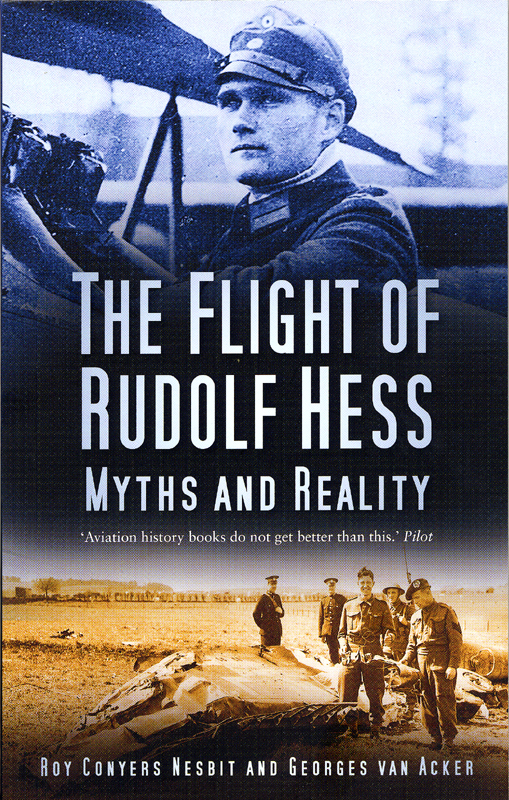
The Flight of Rudolf Hess Myths and Reality frontcoverThe History Press 2011
Intrigued by the enigma, many writers have produced books over the years – some, unfortunately, now discredited, although all are interesting to read! In my opinion, one of the best is a relatively short book, first published just 13 years ago: The Flight of Rudolf Hess – Myths and Reality, by Roy Conyers Nesbit and Georges Van Acker (Sutton Publishing, 1999. 172pp. ISBN 0750923865).
Roy Nesbit is a specialist writer on aviation history; his collaborator, Georges Van Acker, who is Belgian, contributes an amusing dedication at the start of the book, to his wife: ‘For Wilma Van Acker, who endured with patience her husband’s preoccupation with Rudolf Hess for more than seven years’. (May I recommend – if funds permit! – that readers seek out the original hardbound edition of this book; the pages – 242x165mm – are much larger, and the photos much more nicely reproduced.)

Prestwick International Airport, near to Glasgow, South Ayrshire, Great Britain Source Wikipedia
Janice, Jean-Claude, Marie-Agnès, before plunging into the Hess story, I’d like to say just a little about Prestwick Airport itself, for it has a long and interesting history. (In May last year, it was reported that a historian – by the name of Harris, I think – had done some new work, proving that Prestwick Airport itself had been Hess’s intended destination, rather than Dungavel House, Strathaven, as earlier writers had always stated. But Nesbit and Van Acker make it clear that The Duke of Hamilton – whom Hess hoped to meet – was in command at RAF Turnhouse, Edinburgh, by this time. It had always been Hess’s intention to crash-land his new plane, of course – it was one of the latest type – and to burn it, if necessary, so that it would be destroyed.)

Source: http://www.elvis-express.com/elvisradio_articles_prestwick.html
One of the first things visitors tend to notice at Prestwick is a large gold star, set into the concourse beside the main entrance. The inscription reads: ‘Elvis Presley – Prestwick is the only place in the United Kingdom visited by the King of Rock ‘n’ Roll. Sergeant Presley was greeted by screaming fans on 3 March 1960 when his aircraft stopped to refuel .. ‘ (Elvis was returning to the USA from National Service in West Germany; in fact, construction work on the current terminal building did not begin until June 1961, and it was actually at the adjacent Greensite USAF base that the ‘King’ was mobbed by hysterical fans, signing autographs and posing for pictures. Prestwick was then an international airport, its runway having been lengthened to accommodate the largest planes. Elvis never sang in the UK because of a dispute with the British Musicians’ Union – they wanted their members employed in support of Presley, Elvis insisted on his own backing quartet, The Jordanaires.)

Douglas Douglas Hamilton 14th Duke of Hamilton aka Lord Clydesdale - Source: Wikipedia
But the origins of today’s Glasgow Prestwick Airport can be traced to August 1935, when two quite unusually talented young Scotsmen founded a new company there, Scottish Aviation Ltd, in association with the de Havilland Aircraft Co. The men were David F McIntyre, from Ayr – largely responsible for choosing the site of the future airport, as he knew its excellent weather record – and Douglas Douglas-Hamilton, who as heir to the Duke of Hamilton was a member of one of Scotland’s most important noble families. (Douglas Douglas-Hamilton, 1903-1973, had the title at this time of Marquis of Douglas and Clydesdale; by 1940, his father had died and he became 14th Duke of Hamilton – the man whom Hess claimed he’d come to see, although they’d never met.)

First flight over Everest 1933, Lord Clydesdale piloting - Source Wikipedia
Dear Friends, please be patient, for I know that this is an irrelevant digression from our story, but it’s something I simply must mention (it’s ‘now or never’, Marie-Agnès!) – in 1933, the two business partners had set a new altitude record by flying their Westland biplanes over the summit of Mount Everest! The small planes, selected for their climbing ability, were carried overland in crates and assembled in India, as part of what was known as the Houston – Mount Everest Aerial Survey (these parts of the Himalayas had not previously been mapped).
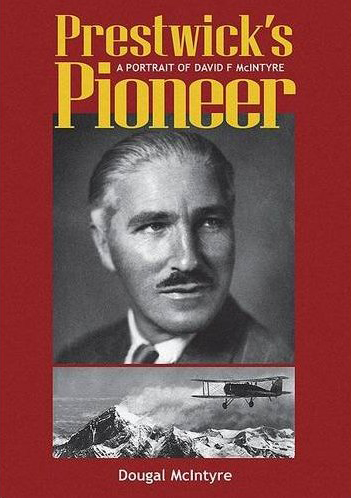
Prestwick's Pioneer by Dougall McIntyre - Woodfield Publishing 2004
Clearly McIntyre and Douglas-Hamilton were brilliant aviators; the shared adventure cemented their friendship. Soon afterwards, they published an account of the affair: The Pilot’s Book of Everest (Hodge, London, 1936).
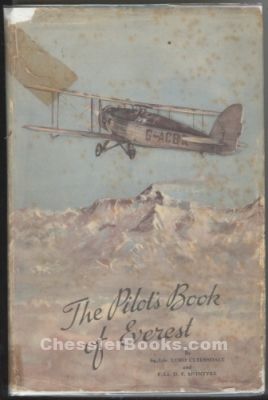
The Pilots' Book of Everest Hodge London 1936
More than 1300 pilots and 2000 navigators had been trained at the Scottish Aviation flying school by 1939. With the outbreak of war, the assets of the Company were taken over and the installation became a Royal Air Force station, McIntyre being promoted to the rank of Officer Commanding. Douglas-Hamilton, meanwhile, had been given a very senior rank in the RAF, having charge of air defence in Scotland and Northern England, and responsibility for the Air Training Corps. (Astonishingly, he and all three of his brothers held at that time the rank of Squadron Leader – or above – in the Royal Air Force.)
But to our tale. According to Nesbit and Van Acker, Hess’s flight to Scotland is really much simpler and more straightforward than so many writers have suggested. Hess planned the journey for at least six months – the letter to his wife, Ilse, dated 4 November 1940, proves this. He waited for a suitable opportunity, suitable weather, a suitable plane. His authority as Deputy Führer, and his relationship with such people as Willy Messerschmitt, head of the aircraft works, gave him considerable freedom of action.
Hitler did not order or authorise the flight, and knew nothing about it beforehand – and was, of course, furious when he found out. A short quotation from Nesbit and Van Acker: “Hitler’s reaction was described by his architect, Albert Speer, who happened to be waiting (nearby) with some drawings. In his autobiography, he wrote: ‘While I was leafing through my sketches once more, I suddenly heard an inarticulate, almost animal-like outcry. Then Hitler roared, ‘Bormann at once! Where is Bormann?’ Bormann was told to get in touch with Goering, Ribbentrop, Goebbels and Himmler by the fastest possible means.’ The outcome was predictable. Pintsch and Hess’s other adjutant, Alfred Leitgen, were arrested, as well as all close members of his entourage.”
Hess had suggested that, if his mission were to fail, a statement should be issued via the news media stating that he was mad. This was duly done. “It would appear that Hess was suffering from the hallucination that by undertaking a personal step .. .. it might be possible to bring about an understanding between Germany and Britain.” Pintsch was punished by being sent to the Eastern Front.
Sitting by the window last Saturday evening, just after 10 o’clock, I tried to imagine the scene at Floors Farm, Eaglesham, on that Saturday night all those years ago. How I’d like to have been there! The light was fading fast, although it wasn’t yet completely dark – just as conditions would have been at 11.09 on 10 May 1941, the precise moment of Hess’s arrival ( ‘double’ summer time was in operation, the clocks advanced by two hours from GMT).
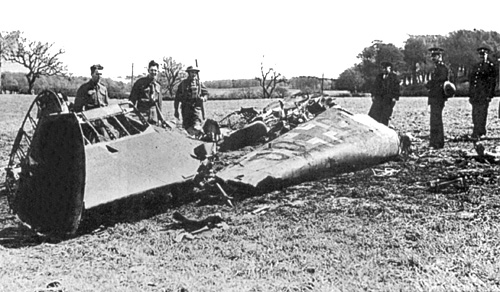
The wreckage of Hess's Bf 110 in Bonnyton Moor Scotland May 10th 1941 Source Wikipedia
Nesbit and Van Acker describe those dramatic events:
“David McLean, head ploughman at Floors Farm, was preparing to go to bed when he heard the noise of an aircraft overhead. (A bachelor of about 45, he lived in a simple cottage there with his mother.)
Then the engines stopped, and a few minutes later there was an explosion. Looking out of the window, he saw a parachute floating down and went outside to investigate. The man beneath hit the ground and was dragged along by the billowing parachute. McLean helped him to his feet and saw that he was wearing a foreign uniform under his flying clothes. When asked if he was German, Hess replied in good English: ‘Yes, I am Hauptmann Alfred Horn. I have an important message for the Duke of Hamilton.’
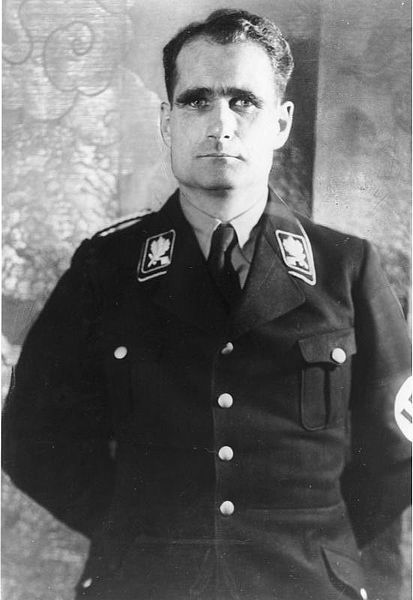
Rudolf Hess Source Wikipedia
“McLean checked the German for weapons and then gathered up the parachute. He was much smaller than Hess, but helped him into the cottage (he’d landed badly, injuring his leg and back). Mrs McLean was busy dealing with the excitement in the usual British way, by making a pot of tea. Hess refused tea but asked for a glass of water. His hosts were impressed by his courteous manner, his well-cut uniform, hand-made flying boots and fine gold wristwatch.”
Within minutes police, home guard and army men were on the scene, and Hess was placed under arrest. (He was to know nothing but imprisonment – in varying degrees of comfort – for the remainder of his long life. Sentenced to life imprisonment at Nuremberg for ‘Crimes against Peace’ and ‘Conspiracy with Others’, he died in Spandau Prison, West Berlin in 1987, at the age of 93.)
From Eaglesham, Hess was taken first to the headquarters of the Home Guard at Busby, near Glasgow. He made rather a good impression on Major Graham Donald, who questioned him: ‘He is, if one may apply the term to a Nazi, quite a gentleman .. .. I found him to be a very interesting and quite pleasant fellow, not in the least of the tough young Nazi type .. .. ‘
At Maryhill Barracks, Glasgow, the following morning, Hess’s wish to meet the Duke of Hamilton was finally granted. “Hess introduced himself by his correct name and said that he had seen Hamilton at the Olympic Games of 1936 in Berlin.
He had come on a mission of humanity, for Hitler did not want to defeat Britain but instead hoped to stop the fighting. .. .. (But) he had completely misjudged Hamilton in believing that he would take any action that would hinder Britain’s successful prosecution of the war. Hamilton told Hess that if Britain made peace now, the two countries would be back at war within two years.”

Castle Buchanan in late 1890's Drymen Scotland - Source Wikipedia
Hess’s peace mission had failed. From the sick bay of Maryhill Barracks, Hess was transferred to the military hospital at Buchanan Castle, Drymen, where his injuries could be better treated. He was then held briefly in the Tower of London, before lodging for a year or so at the fine house known as Mytchett Place (in Surrey, a beautiful part of England). Here he was kept secure by a force of 150 Scots Guards – an expensive arrangement! As time passed, Hess’s mental condition began to give cause for concern – it’s a long story. For the last years before the war ended, Rudolf Hess had the use of two small rooms at Maindiff Court Hospital, near Abergavenny, South Wales. He had made several attempts at suicide, and it was thought that Hitler had ordered a secret agent to try to assassinate him. ‘He deserves to be shot!’
Dear friends, the full story of Rudolf Hess’s flight – and of earlier attempts to make peace with Britain – is a long and complicated one; historians are frustrated that some of the documentary evidence remains classified as secret, even after the lapse of so many years. But I hope to have given you something of the flavour of this bizarre yet fascinating tale!
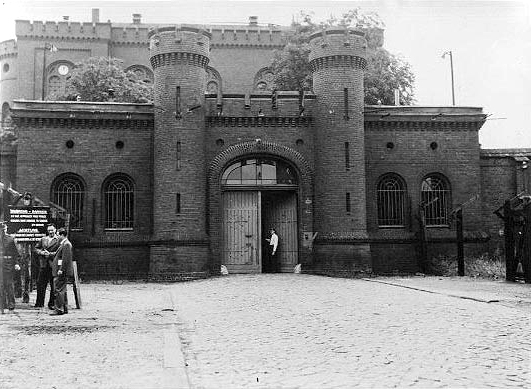
Spandau Prison in Berlin Germany 1951 Source Wikipedia
A bientôt.
Iain.

Le vieux pont and the old Cité de Carcassonne by night Source Wikipedia
Surrounded by secrecy from the start, Mr Churchill waited 72 hours before allowing the newspapers to print their short, censored reports of the Hess landing at the Bairds’ farm near Eaglesham. Not a word would have been reported at all, had Rudolf Hess touched down safely at his intended destination, the small but illuminated wartime airfield, RAF Dundonald, close to Prestwick. (John Harris and Richard Wilbourn : ‘Rudolf Hess, A New Technical Analysis of the Hess Flight, May 1941’ – History Press, 2014.)
Harris and Wilbourn have identified Hess’s plane as a BF110E-2/N, completed on 21 November 1940. Weighing some seven tons and designed for a crew of two, it had twin Daimler-Benz engines and was Messerschmitt’s fastest plane to date. The authors show that, to reach Scotland from Bavaria, it would have been necessary to refuel in North Germany or perhaps the Netherlands. Rudolf Hess must therefore have been given much practical assistance to come to Scotland. It follows that his flight must have been ‘official’ and authorised by Hitler.
Hess arrived over the Northumberland coast before traversing Scotland from East to West, trying to find his bearings. Reaching the west coast, he turned back inland, still unsure of his position. The darkness was almost complete. As his supply of engine oil became exhausted, Hess was obliged to ‘bale out’ to avoid being killed in the crash-landing that would inevitably follow.
Adolf Hitler’s (reported) reaction to hearing of the flight was consistent with his established attitude towards speaking the truth: “Always tell a big lie. You are much more likely to be believed.”
I’ve been looking also at Alfred Smith’s book, “Rudolf Hess and Germany’s Reluctant War, 1939-41” (The Book Guild, 2001) – one of the more significant books on Hess, I think, and a long one, of over 450 pages. Mr Smith’s book has a ‘completeness’ to it which is very satisfying. There is much information on the political situation in Europe and the historical background to it, as well as some glimpses of the character and personality of Rudolf Hess himself. Alfred Smith has had a lifelong interest in the Hess affair, and must now be quite an elderly gentleman. He and Hess’s son, Wolf Rüdiger Hess (1937-2001) were friends.
In May 1941 Winston Churchill had been Prime Minister for almost exactly a year; he was popular in the country because of the effectiveness of his broadcasts on the BBC, but politically he was much less secure, for his National Government was disunited. The Luftwaffe had failed to win the Battle of Britain, nevertheless Britain’s situation was desperate. Only the English Channel, it seemed, prevented a German invasion. Prominent voices called for us to seek peace terms.
All of the most recent writers on this affair agree that British Intelligence(with or without Churchill’s authorisation)had corresponded with Rudolf Hess, pretending that the letters had come from the Duke of Hamilton. (This was quite easily done, by sending the letters via an intermediary in some neutral country, such as Portugal or Switzerland.) The purpose here, of course, was to convince Hess that his proposals would be well received. The Duke of Hamilton – supposedly – would introduce Hess to King George VI, who – according to our Constitution – had the authority to dismiss the ‘warmonger’ Churchill as prime minister.
Rudolf Hess’s proposals were rejected, and his ‘secret’ mission had become public knowledge – a double failure. The war continued with increased savagery and bitterness; it became ‘a fight to the finish’.
How many more years must pass before the last files are released on the Hess flight of 10 May 1941? It’s known that some, at least, have been destroyed.
Winston Churchill’s sympathy for Hess increased when the Nuremberg court condemned him to life imprisonment. In his book ‘The Grand Alliance’, Churchill made his feelings clear :
“Whatever may be the moral guilt of a German who stood near to Hitler, Hess had, in my view, atoned for this by his completely devoted and frantic deed of lunatic benevolence. He came to us of his own free will, and, though without authority, had something of the quality of an envoy. He was a medical and not a criminal case, and should be so regarded.”
Iain.