



The “Sentinels of the Passage”: Oban to Mull …
Hi everybody,
“Oban and Mull”: two magical names that still set me dreaming. They bring back memories of the crossing from Oban’s busy harbour to Craignure, on the Isle of Mull.
Come aboard and follow the shoreline with me, where ancient castles, lonely islets and steadfast lighthouses keep watch over a passage steeped in history and legend.
But this is no ordinary crossing. The “Sentinels of the Passage” will let you cross only if you pause to hear their stories…;-)
“First, do as I do on every crossing: pull on a parka suited to Alba’s changeable weather, then brave the wind and step out onto the ferry’s windswept deck.”

Caledonian MacBrayne ferry Isle of Mull © 2006 Scotiana
The ferry! That majestic, almost mythical vessel, carrying travellers from one world to the next…
The Caledonian MacBrayne ferries ! Dream-carriers, taking travellers to far-flung destinations such as Mull, Iona, Barra, Harris and Lewis, North Uist and South Uist, Islay and from Islay, you can even continue to Jura on a short connecting ferry across the Sound of Islay.,
And… YES, the Isle of Skye, “the Misty Isle”! You can choose not to take the bridge, but instead to cross by ferry from Mallaig to Armadale. Another magical crossing is the one from Glenelg to Kylerhea, aboard the MV Glenachulish, the little manually operated turntable ferry.
We have spent hours watching these great ships arrive and depart, stirring the imagination of travellers already dreaming of their next journey.
But we did more than stand and gaze dreamily at them: we boarded these ferries many times and set sail for a variety of destinations. Among all those journeys, however, the crossing from Oban to the Isle of Mull remains one of our most memorable crossings in Scotland.

Oban by night © 2019 Scotiana
Today, our virtual adventure begins in Oban, the much-loved “Gateway to the Isles”. I have wonderful memories of our last visit, shortly after Christmas 2019. The streets were decked with festive garlands, their colourful lights shimmering in the harbour waters.
Robert Louis Stevenson, too, was captivated by Oban after dark. Writing to his parents on 4 August 1880, he recalled an enchanting evening when a yacht lay in the bay and its lights mingled with the spectacle on the water:
“At Oban, that night, it was delicious. Mr Stephenson’s yacht lay in the bay, and a splendid band on board played delightfully. The waters of the bay were as smooth as a millpond; and, in the dusk, the black shadows of the hills stretched across to our very feet and the lights were reflected in long lines. At intervals, blue lights were burned on the water; and rockets were sent up. Sometimes great stars of clear fire fell from them, until the bay received and quenched them. I hired a boat and sculled round the yacht in the dark”
My own evening in Oban was quite different from Robert Louis Stevenson’s. It was raining as I walked along the pier, and the raindrops caught the harbour lights, scattering them into countless tiny points of light.

One ferry was sailing away; another lay alongside the pier, ready for its next departure. I watched them, imagining myself on board, setting off once again towards the islands. We had made this crossing many times by day, but that evening I found myself dreaming of a night passage, when familiar landmarks might gradually emerge from the darkness. As the great vessel made its way into the Firth of Lorn, would I recognise the Sentinels that had watched over these waters for generations? What stories might they whisper to a traveller willing to listen?
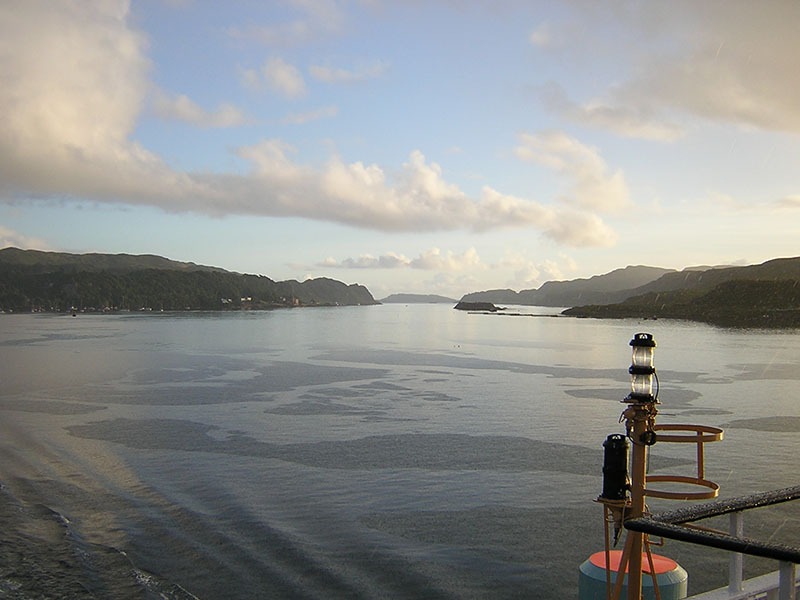
Bay of Oban – view from the ferry © 2003 Scotiana
“Lend an ear to the Sentinels, those mysterious keepers of the threshold, and the crossing will reveal its wonders: the sea, the islands, the hills fading into mist, the whole Scottish landscape unfolding around you, changing with every shift of light. You may never see this passage in quite the same way again.”
(Ailean)
I first tried to capture the magic of this crossing in two earlier Scotiana posts: The Wonderful Colours of Scotland: BLUE…, published on 22 June 2014, and The Best of Scotland – Argyll & the Isles: From Oban to Mull, published on 6 February 2015.
In the latter, I wrote that “the crossing between Oban and Mull is in itself a feast.”
More than ten years later, I find myself returning to that same passage, but with a different purpose. This time, I want to linger over a few of its guardians and listen to the stories they seem to keep.
No sooner had the ferry left the harbour than the first sentinels began to emerge, one after another, along the shore. Their silhouettes appeared against the fading light, each with a story of its own.
Dunollie Castle — the sentinel of the shore
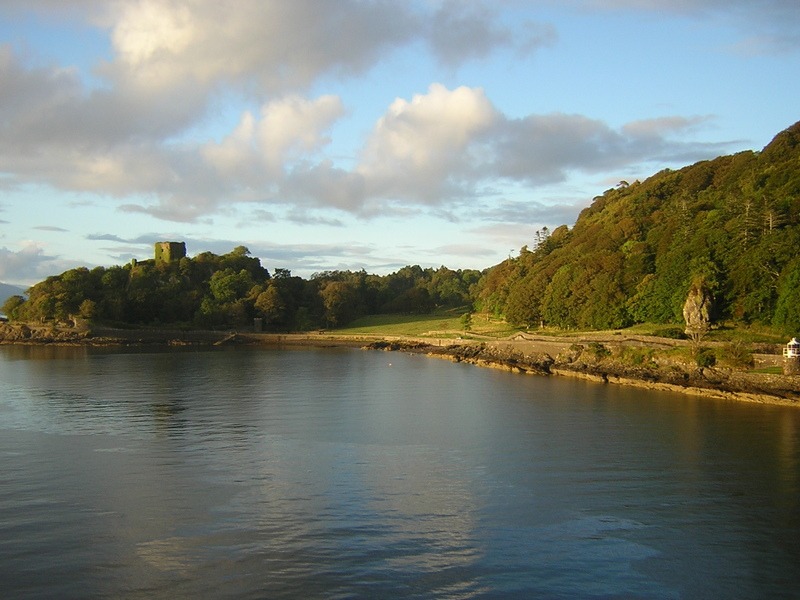
Dunollie Castle – A view from the ferry Oban © 2003 Scotiana
“The ferry slips away, the castle remains on shore, but the traveller carries the silhouette of the old guardian with them.”
(Ailean)
Close to Oban stands Dunollie Castle, its ruined tower rising above the greenery on a rocky headland. Even from the water, it seems to keep watch over the harbour, a silent reminder of the ancient lords of Lorn.
The Dog Stone — An Unexpected Sentinel
After so many years of watching Dunollie Castle’s familiar silhouette appear and disappear from the ferry deck, we finally decided it was high time we took a closer look at its moss-covered ruins.
It was not until our last visit to Oban, in the winter of 2019, that we finally braved the elements and followed the path along the bay towards the old castle. The rain was pouring, and the wind was bitterly cold, making our walk quite unforgettable.
Beside the path stood an old wooden bench, soaked by the rain but decorated with Christmas garlands. A little farther on, we came across a huge rock known as the Dog Stone. Another sentinel, though not one visible from the ferry, it immediately caught our attention. Naturally, we had to hear its story.
According to local legend, the giant Fingal (Fionn mac Cumhaill) used to tie his mighty hunting hound, Bran, to the rock while he went hunting across the Hebrides. The groove around the base is said to have been worn by the dog as he circled restlessly, straining at his tether and waiting for his master to return.
Maiden Island — a story written in the tide
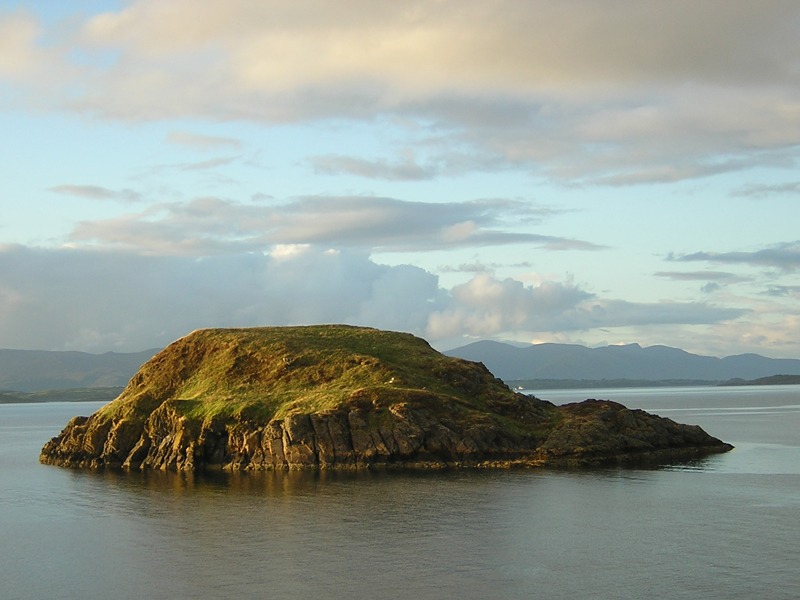
Maiden Island – A view from the ferry Oban © 2003 Scotiana
Not far from the shore lies Maiden Island, a small, rocky islet whose shape and name invite the imagination.
Several legends are associated with this lonely place. One tells of a young woman accused of wrongdoing, tied up by the shore and left to face the rising tide. Another recounts the tragic fate of Mhairi and her lover Muireadhach, whose attempt to save her ended in disaster. The details vary from one telling to another, but the sea has the final word in each.
Perhaps, as you pass this little sentinel, you might almost hear an echo of those old laments, carried away by the waves.
Lismore Lighthouse — the guardian of the waters

Oban-Mull Lismore lighthouse © 2003 Scotiana
Ahead, the magnificent white tower of Lismore Lighthouse rises from the tiny island of Eilean Musdile. Designed by Robert Stevenson and first lit in 1833, it has guided ships through these waters for nearly two centuries.
A faithful guardian, it seems to stand watch over every vessel passing through the Firth of Lorn. I can almost hear it warning the unwelcome visitors of old: “Ships in distress, come safely through; pirate ships, you shall not pass!”
Duart Castle — The Old Guardian of Stone
And then, on the shores of Mull, Duart Castle comes into view: the old guardian of stone, rising above the sea.
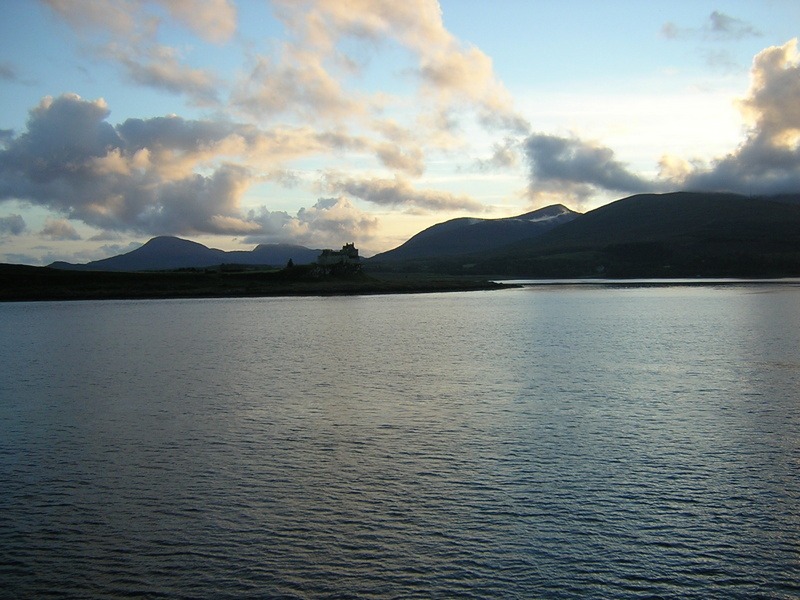
Duart Castle – The Old Guardian of Stone © 2003 Scotiana
The light is slowly fading. The sea still reflects the shades of blue in the sky, while the clouds hold the last traces of sunlight. But night falls quickly here. The water turns grey, and suddenly, on the darkening shore, the imposing silhouette of Duart Castle emerges: the last, and perhaps the most formidable, of the Sentinels of the Passage.
A silent guardian of stone — but is it really silent? I wonder…
All around us, the evening seems quiet. As the ferry draws closer to the shore, the old fortress gradually becomes clearer against the darkening sky. How imposing it looks! Can I make out cannons up there? Surely the days of cannon fire are long gone… or are they?
I shall greet the old guardian anyway, just in case it feels like sharing a few secrets with us. But the stone giant seems to be asleep and in no mood for conversation. We shall have to return in daylight.

Arrival of the ferry on Mull at Craignure terminal © 2003 Scotiana
Our ferry continues towards Mull, eventually drawing alongside the pier at Craignure. The little harbour marks our arrival on an island that is itself a gateway to other remarkable places, including Iona and Staffa. Yet, as with so many journeys in Scotland, arrival is only the beginning of another adventure.

A view of Duart Castle from the ferry Oban-Mull © 2004 Scotiana
After spending the night at the little campsite at Balmeanach, we returned to meet our stone guardian in daylight. At dawn, we had been woken by such an astonishing chorus of unfamiliar bird calls that I wondered whether there might be an aviary nearby!

Duart Castle Isle of Mull Scotland © 2004 Scotiana
In daylight, Duart Castle looked no less impressive than it had in the gathering darkness. Perched high on its rocky promontory, it seemed to command the entire maritime landscape.
And its position was no accident. Standing on a high rocky outcrop at the end of a peninsula jutting into the Sound of Mull, the castle commands the channel between Mull and the mainland, the entrances to Lochs Linnhe and Etive, and the narrow stretch of the Firth of Lorn where it meets the Sound of Mull.
For centuries, this was a strategic crossroads for ships navigating the waters around Scotland’s western coast.
At the heart of the fortress stands the fourteenth-century keep, built around 1360 by Lachlan Lubanach Maclean, Chief of Clan Maclean of Duart. The other wings were added during the sixteenth and seventeenth centuries. The Macleans lost possession of the castle in the late seventeenth century, when it passed to the Earl of Argyll. Abandoned in 1751, it gradually fell into ruin.
In 1911, Sir Fitzroy Maclean bought back the ancestral stronghold and undertook its restoration, bringing the old castle back to life.
No wonder this old Sentinel seems to have so many stories to tell. After centuries of conflict, abandonment and restoration, it still watches over the passage — silent, steadfast and impossible to ignore.
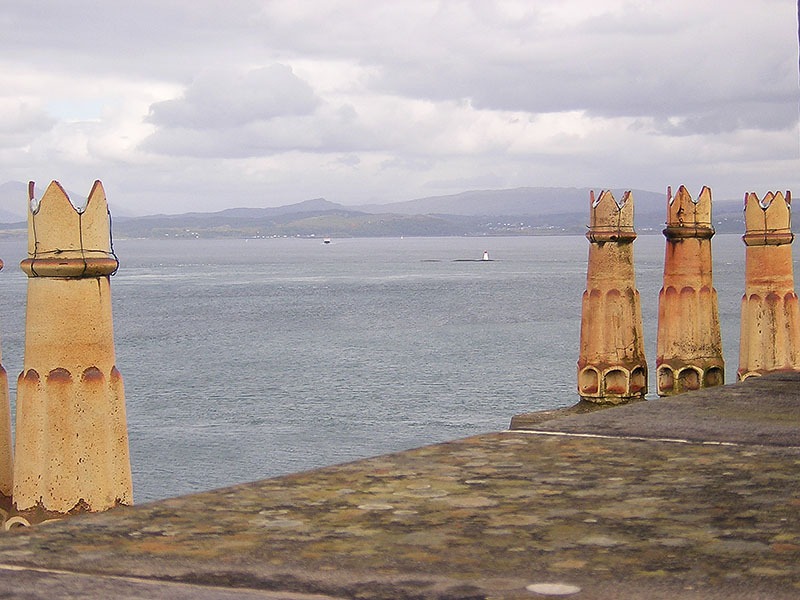
Duart the sentinel Lady’s Rock © 2004 Scotiana
From the castle ramparts, framed by a row of handsome chimneys, our gaze wanders towards a small, low rock in the Sound. At first, it seems no more than an insignificant speck beneath the vast Scottish sky. Yet this is Lady’s Rock, a sentinel of the tides whose lonely outline conceals one of the darkest tales associated with Duart Castle.
A small red-and-white beacon marks this dangerous reef, which is submerged at high tide. The date of the first beacon is not recorded, and its original lantern was replaced in 2001.
Try to imagine the view in the early sixteenth century, without the modern warning light and with a very different silhouette of the castle above the shore. Picture instead a jagged, seaweed-covered rock, isolated in the Sound and disappearing completely beneath the rising tide.
“Catherine Campbell…”
On this small islet, your name seems written for ever,
“Catherine Campbell…”
The howling wind still echoes with your desperate cries…
Sometimes, in the imagination, the delicate figure of a woman seems to emerge through the mist, somewhere between the lonely rock and the castle overlooking it.
According to one version of the old tale, Lachlan Cattanach Maclean, Chief of Duart, abandoned his wife on the rock as the tide began to rise. A passing fisherman heard her desperate cries and rescued her before the waters engulfed the reef. Other versions tell of her rescue by members of her own family.
The woman’s name also varies in historical accounts and later retellings. Some older histories identify her as Elizabeth Campbell, while Sue Lawrence’s historical novel Lady Rock tells the story of Catherine Campbell. The details of the episode, including the circumstances of her rescue and her husband’s intentions, remain uncertain. The tale has been passed down through several versions, all adding to the mystery surrounding this lonely rock.
Some tellings also link the episode to the later killing of Lachlan Cattanach in Edinburgh, in 1523, by Sir John Campbell of Calder, the woman’s brother. Was it vengeance for what had happened on the rock? The story has become entangled with the bitter rivalries between the Macleans and the Campbells.
Sue Lawrence has given this dramatic tradition a powerful literary voice in her historical novel:
“The tide was coming in fast. She scrambled up the slippery rock as the water lapped over her feet.
She had reached the top of the jagged, rocky outcrop in the middle of a tempestuous sea.
She had nowhere else to go. The icy water was soon up to her ankles
and all she could do was stretch her head high imploring the heavens to save her…”
(From Lady Rock by Sue Lawrence, Saraband, 2024.)
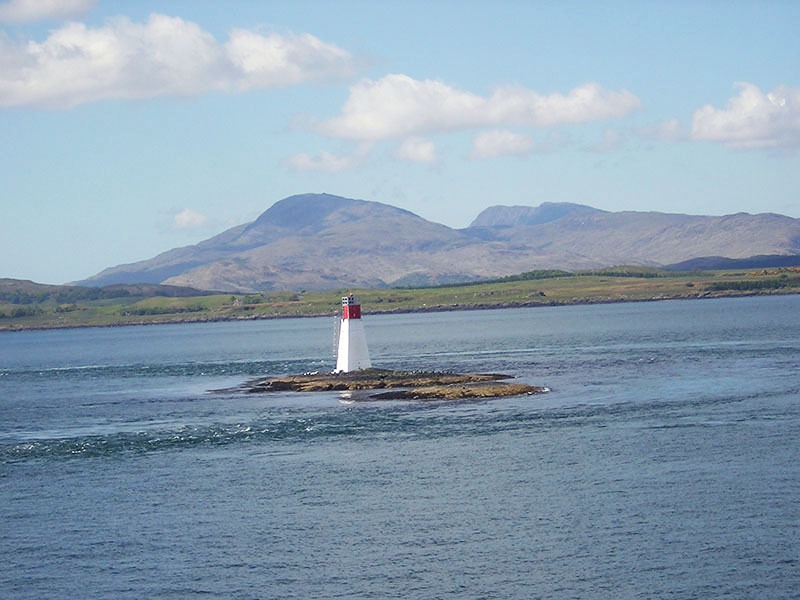
Lady’s Rock view from the ferry Oban-Mull © 2004 Scotiana
From the ferry, the little rock looks almost insignificant. Yet, knowing its story, it is difficult to pass without imagining the rising tide, the lonely figure and the cries carried away by the wind.
“The ferry leaves the old fortress behind, but Duart Castle remains, keeping watch over the waters long after the ship has disappeared from sight.”
— Ailean
Craignure — the threshold of Mull
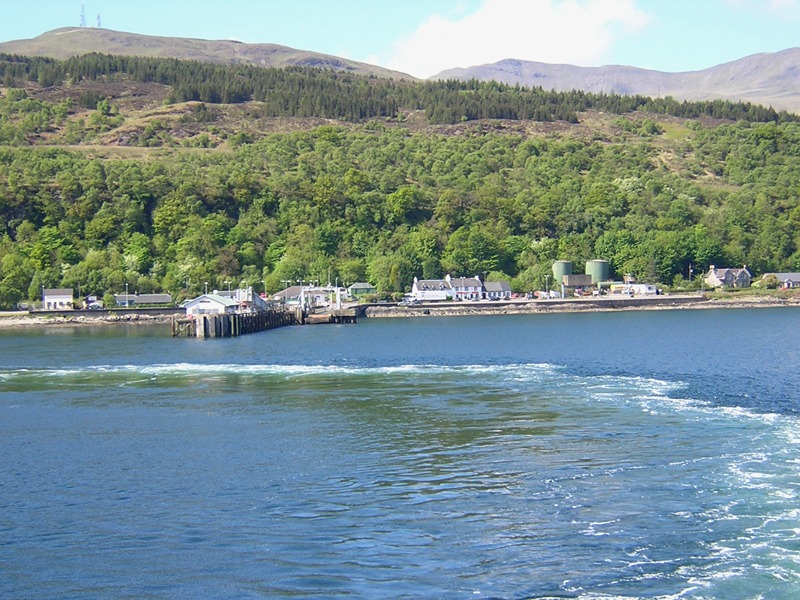
The island of Mull – Craignure ferry terminal © 2004 Scotiana
Craignure marks the end of our crossing from the mainland, but certainly not the end of our journey. This little harbour is the gateway to an island full of remarkable places, from its wild landscapes and historic sites to the sacred shores of Iona and the extraordinary beauty of Staffa.
The Sentinels have been watching us all along. Some have spoken through legends, others through their silent presence. The lighthouse has kept its light for passing ships, while the old castle has stood guard over the shore.
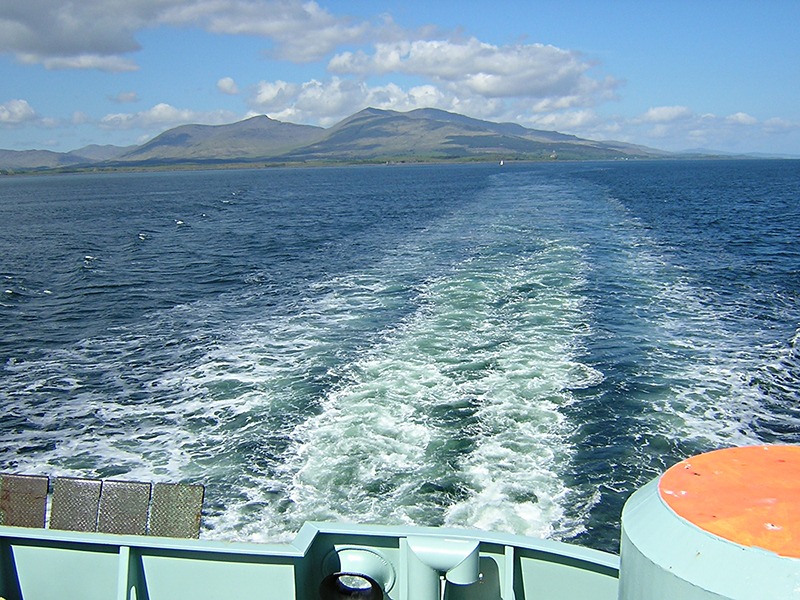
Oban-Mull-Barra © 2004 Scotiana
And the crossing itself? It remains a world of its own, a place between departure and arrival, where the sea, the islands and the changing light all become part of the story.
Before I take you on another journey to discover the magic of a different crossing aboard one of the flagship vessels of Scotland’s ferry fleet, why not imagine yourself on board the Isle of Mull, sailing from Oban to Craignure under the watchful eyes of the Sentinels?
Enjoy the crossing!
But don’t forget to listen to the Sentinels! 😉
À bientôt,
Mairiuna
Comments
The “Sentinels of the Passage”: Oban to Mull … — No Comments
HTML tags allowed in your comment: <a href="" title=""> <abbr title=""> <acronym title=""> <b> <blockquote cite=""> <cite> <code> <del datetime=""> <em> <i> <q cite=""> <s> <strike> <strong>